Sunday, February 7, 2010

Finding strength

Life happens all around us - work, play, love. For the last week or so, I've let exam preparation consume my life, and as it did, my emotions have spiraled out of control. Exhaustion, as my motivation dwindled down. Frustration, as my head and eyes began to ache continually. Isolation, as cabin fever left me longing for any kind of human interaction. Anger, as my printer jammed up for the third time. Fear, as I look towards tomorrow's test. (I know, it sounds like the path to the Dark Side of the Force!)

This depressing affect has left me discouraged and inwardly attention seeking. It's easy to forget, then, who it is who has brought us this far. Letting the trials and tribulations overwhelm us, we forget that he'll also see us through to the end.

PHILIPPIANS 2 (NIV)

13...for it is God who works in you to will and to act according to his good purpose.

14Do everything without complaining or arguing, 15so that you may become blameless and pure, children of God without fault in a crooked and depraved generation, in which you shine like stars in the universe.

Therefore, persevere to the end.

Saturday, June 20, 2009

The source of faith

I recently had a conversation with a colleague from work who expressed to me that there is no true religion. "How can there be?" she said, "There are so many!"

From her perspective, religion is an annoying crutch on which the weak lean in times of trouble. From my perspective, times of trouble force people to pause and look beyond their own immediate surroundings, allowing religion to find room. It's not that problems cause people to seek religion, it's that religion calls people out during times of trouble.

She replied, "Well, if you already believe in something, then you're obviously going to answer all questions from that perspective." And yet, atheism is a perspective as well, one that she was obviously answering the question from.

The question of how many religions there are is irrelevant as to whether one is true or not. Truth is not bound by how difficult it is to decipher nor by how many people believe in it. Truth is truth. A believer does not subscribe to religion merely because they hope to be a "better person" or to summon "strength" but also because they believe it to be true. That is the very definition of faith, yet it is not only the faith that is important, but also the truth.

Today, while perusing through some of my high school journals, I found this lesson posed just so:

If a man has great faith in thin ice, he will still drown. If a man has little faith in solid ground, he will still live. Therefore salvation does not depend on the amount of faith, but on the basis of that faith. My faith is in the Lord, the true and only God.

As Christians, we choose to build our faith on Christ, because we believe his words to be true. Without God, without Christ, there is no Christianity.

MATTHEW 7 (NLT)

Building on a Solid Foundation

24 “Anyone who listens to my teaching and follows it is wise, like a person who builds a house on solid rock. 25 Though the rain comes in torrents and the floodwaters rise and the winds beat against that house, it won’t collapse because it is built on bedrock. 26 But anyone who hears my teaching and doesn’t obey it is foolish, like a person who builds a house on sand. 27 When the rains and floods come and the winds beat against that house, it will collapse with a mighty crash.”

28 When Jesus had finished saying these things, the crowds were amazed at his teaching, 29 for he taught with real authority—quite unlike their teachers of religious law.

Sunday, April 12, 2009

The uncanny Lord God


MARK 16 (NLT)
The Resurrection
1 Saturday evening, when the Sabbath ended, Mary Magdalene, Mary the mother of James, and Salome went out and purchased burial spices so they could anoint Jesus’ body. 2 Very early on Sunday morning, just at sunrise, they went to the tomb. 3 On the way they were asking each other, “Who will roll away the stone for us from the entrance to the tomb?” 4 But as they arrived, they looked up and saw that the stone, which was very large, had already been rolled aside.

5 When they entered the tomb, they saw a young man clothed in a white robe sitting on the right side. The women were shocked, 6 but the angel said, “Don’t be alarmed. You are looking for Jesus of Nazareth, who was crucified. He isn’t here! He is risen from the dead! Look, this is where they laid his body. 7 Now go and tell his disciples, including Peter, that Jesus is going ahead of you to Galilee. You will see him there, just as he told you before he died.”

The last couple of days, I have felt as though God has been attempting to convict me of the need to re-prioritize my relationship with him. The latest challenge came from today's Sunday sermon. After all, what better time to have one's attention drawn back to God than a weekend devoted to Jesus' death and resurrection?

Service began with a sharing by one of my former Sunday-school teachers about the passing of her mother due to illness. While the occasion was difficult, she praised that her mother was now no longer suffering and that she would see her mom again one day in paradise. But moreover, she extolled the congregation for their stalwart support of her and their unwavering prayers for her mother during the difficult period prior to her mother's death. She had truly felt taken care of, she said.

As she concluded these words, a flutter of doubt crept in through the back door of my heart. Having recently mourned the passing of my own aunt, I wondered why our active and compassionate God did not simply heal those for whom so many were praying. Perhaps, Satan tempted, God did not exist at all, as so many today would assert.

Of course, it is not by our will that a person lives or dies, but God's own will. Yet couldn't God make his hand more obvious? His authority would be easier to accept if it were more plainly laid before us. Such lures occasionally find their way into my mind, and while they do not ultimately sway my constitution, they can momentarily thrust my heart into confusion.

...

"In my experience, there's no such thing as luck." Obi-wan Kenobi

As if responding to my challenge, God began to weave together the tapestry he had been carefully threading through my life. The first threads had been sewn through my course visits to Alcoholics Anonymous. These visits had prompted many personal spiritual examinations.

This organization recognized the power of the Church structure and of fellowship. They proclaimed the importance of the "grace of God" and humility, and yet they neatly ducked around the actual person of God in whom they had placed their trust. Instead, they endorsed the "God of their own understanding" - be it the AA group itself or a mysterious "energy force" of which we are all a part. So close, yet so far.

At the same time, AA had capitalized on a powerful aspect of fellowship through "sponsorship" of new members, pairing a mentor and a seeker at all times. They kept sober by sharing what they had learned, and they received sobriety by learning from others. Perhaps, in all its similarities, the Church would benefit from such accountability and generosity, I thought.

...

It was talking to my brother about the lull in my spiritual development that the answer arrived. It was unexpected and unrecognized at the time. Everybody needs a Paul, and everybody needs a Timothy, he said.

Paul is the spiritual mentor, the one from whom we can seek advice and learning. Timothy is the spiritual receiver, the one with whom we can share and encourage. Christian growth, he argued, requires both. A Paul and a Timothy. Sponsorship is not a novel invention by Alcoholics Anonymous, it is a formalized type of discipleship, co-opted for secular purposes. Christ had prompted us to share that which we had received from the very beginning, though we often are too reserved to do so. Thus, this aspect of the AA method also seems to borrow from the Church, as Christians have been discipling one another since the apostles themselves.

...

Insurmountable obstacles: our pastor arrived at this point in his Sunday sermon. We are always worrying about how to roll the stone away from the grave - a seemingly impossible task. How do we overcome our propensity to sin? Yet we ought to accept God's sovereignty and his strength to help us overcome improbable odds.

"It's like those 12-Step addiction programs," he continued. "Even they emphasize the need for a higher power as one of the first steps."

"The Twelve Steps" of Alcoholics Anonymous

Step 1: We admitted we were powerless over alcohol, that our lives had become unmanageable.

Step 2: Came to believe that a power greater than ourselves could restore us to sanity.

Step 3. Made a decision to turn our will and our lives over to the care of God as we understood him.

"As Christians," the pastor continued, "we don't simply call upon a higher power, but upon the highest power."

I sat up straight in my seat. I had never heard AA mentioned in a sermon before, and certainly had never encountered the twelve steps. How unusual was it that this pastor would bring up AA just after the month I had spent becoming familiar with it. Even more so, his sentiments echoed my own disappointment at AA's inability to grasp that final revelation of utmost importance - Who is this God?

God was replying to my thoughts about my AA experiences through my brother and through my pastor. Indeed, it seems quite plausible that it was God who had seeded such reflection to begin with. Uncanny, I thought. In my mind, I was already trying to commit these revelations to memory so I could scrawl them down later. The uncanny Lord God, my brain hurriedly titled the experience.

Then it came, the description of the angel by the pastor - "He seemed to have some uncanny knowledge about God. He knew things about Jesus." Now I don't know how much you hear the word "uncanny" in everyday conversation (if you read my writing, then perhaps more often than is typical), but hearing that word come out of my pastor's mouth licking at the heels of my own thoughts was staggering.

...

Fear not!

At the beginning of the service, the pastor had introduced a little bit of interactivity to his sermon. "At times," he told the congregation, "I am going to say, 'Jesus is alive!' I would like you to respond with 'Hallelujah!' At other times, I am going to say, 'Christ is risen!' I would like you to respond with, 'He is risen indeed!'"

Throughout the service, I mumbled through these exchanges; but by the time we arrived at "uncanny" I was ready to jump out of my seat, pump my fist in the air, and yell, "Hallelujah!" But I didn't. Something in my heart was afraid of breaking down that wall and being undignified, of expressing the praise that was bursting out of my heart. As I pondered this with guilt, the next few words spilled out of the pastor's mouth...

"What are we afraid of?" Gotcha.

MARK 16 (NLT)

15 And then he told them, “Go into all the world and preach the Good News to everyone.

God was speaking to me today through a series of coincidences. He was speaking to me this month through a set of experiences. He was calling me back to him, calling me to growth, and calling me to share his love with others. I was afraid. I am still afraid.

But it is our journey and our challenge to put into practice that which we have learned, and to walk the path that God has set before us. I'm sure that with God's faithfulness and strength, he will enable me to finish that which he has begun.

...

To conclude his sermon, the pastor taught us a short four-line prayer.

Jesus is here.
Thank you God.
Help me God.
Help my brother or sister.

Jesus is here. Thank you God that during this season of remembrance, when we reflect on the suffering and death of Jesus Christ, we need not be filled with sorrow. Instead, we can rejoice at your triumph over death and our resultant salvation. Help us to follow you in love and obedience, and in doing so be a blessing to those around us. Amen.

Friday, April 10, 2009

The nature of love

Today, my church conducted a poignant and deeply contemporary Good Friday service. It was the kind of hip, emotional programme that really affected me as a teenager - complete with moody lighting, heartfelt music, and dramatic art. It was incredibly well done. Interspersed between each section were short, pointed messages by each of my church's English pastors.

JOHN 3:16 (KJV)

16For God so loved the world, that he gave his only begotten Son, that whosoever believeth in him should not perish, but have everlasting life.

The service provided plenty of time for prayer and reflection, and sharply reminded me of God's love for us. In the final moments, our head pastor imparted four key responses: Accept God's love. Guard that love. Feed off of that love. Share that love.

This simple message struck a powerful chord with me. As school and life have swirled around me, I have predominantly allowed my walk of faith to coast upon that which I had already established. No longer did I have time for quiet times and scripture readings. I believe in God, and I accept his love, but I simply didn't have time to grow.

God's love is immense, so much so that he took on flesh and died for the forgiveness of our sins in accordance with scripture. How should we respond to this love? We should return it. Reciprocate it. Our love, like God's love, should be an active love - a growing love.

I need to return to a life of devotion and faithfulness, to rekindle the light of joy and love in my own heart. If you happen to find yourself in my shoes today, I hope you will too.

...

Postscript: I recognize too that after walking out of an emotionally charged event or service, it is easy for each of us to have an emotional response. The challenge for us then is to examine that response, and if it is valid, to translate it to more than just a tugging on our emotional heartstrings but a commitment by our soul.

Wednesday, April 1, 2009

God of our understanding

As part of my community health course at school, I've been spending quite a bit of time attending sessions at or related to Alcoholics Anonymous. AA is a pretty unique program geared toward helping alcoholics overcome their addiction. It's laid out as a twelve-step process, supported by other alcoholics. Abstinence to AA is a lifelong and life-changing road. Recipients of the fruits of the program in turn give back what they have gained through sponsorship of other alcoholics, their time, and their commitment.

To AA, recovery is a spiritual process requiring a "psychic change" or radical shift in the way an alcoholic perceives the world (a Christian might call their initial state a "hardened heart"). It requires that they accept that they alone are not in control of their addiction and require a power outside themselves. The often controversial third step of the twelve step program is as follows...

[We made] a decision to turn our will and our lives over to the care of God as we understood him.

The words "as we understood him" are key to modern AA practice. While AA claims to be a spiritual organization, it does not purport to be a religious one. Today, the "God of our understanding" signifies a power beyond ourselves. Some people understand this to be the God of a particular religion, others a general energy force guiding the universe, and still others attribute this to be the power of the group itself.

This raises a number of interesting issues. Firstly, despite its non-religious underpinnings, AA feels familiarly church-like. Meetings generally begin with a prayer (the Serenity Prayer) and key doctrinal readings to AA (the Twelve Traditions and Twelve Steps). These are followed by announcements and then by a speaker. The meeting welcomes newcomers and then closes with a prayer (often the Lord's Prayer).

THE SERENITY PRAYER

God grant me the serenity
to accept the things I cannot change;
courage to change the things I can;
and wisdom to know the difference.

Despite the recognizable structure (akin to opening prayer, scripture reading, announcements, sermon, welcome and introductions, and closing prayer) and even the recital of Jesus' own prayer, AA is a non-religious entity and will remain so.

Speaking to a fellow believer about the church-like feel of AA meetings, they commented, "It feels kind of incomplete to be approaching so close to the truth, yet to shy away from it."

I understood the sentiment. Alcoholics Anonymous had formed under the auspices of the Christian faith, recognizing the effectiveness of that faith yet with the laser-like focus of attacking alcoholism. But the purpose of AA is to treat alcoholism, not to proselytize for Christ or any particular religion. If faith in one particular God is a barrier to helping others overcome alcoholism, then it cannot be integral to AA. It is our job as the church to spread the good news of Christ.

MATTHEW 28 (NLT)

19 Therefore, go and make disciples of all the nations, baptizing them in the name of the Father and the Son and the Holy Spirit.

An interesting dialogue arose during the sharing of an alcoholic at one of the AA sessions I attended. The alcoholic in question was of the impression that God did indeed exist, and he made the following statement:

Religion is man-made.
Spirituality is God-given.

I found this to be an understandable statement, though I disagreed with it. Religion as an institution is man-made, yet the foundation of religion are claims of truth brought to man through revelation. If spirituality is God-given, that is if God exists to share of himself and his nature with us, then it makes sense that God would reveal to us things spiritual. That is what religion is: knowledge about God, and life, and goodness revealed to man through a spiritual interaction with God himself.

JOHN 16 (ESV)

12 "I still have many things to say to you, but you cannot bear them now. 13 When the Spirit of truth comes, he will guide you into all the truth, for he will not speak on his own authority, but whatever he hears he will speak, and he will declare to you the things that are to come. 14 He will glorify me, for he will take what is mine and declare it to you. 15 All that the Father has is mine; therefore I said that he will take what is mine and declare it to you.

Perplexing, though, was that the same man then followed up with this anecdote:

One day we were going over the third step, and my sponsor said, "Oh, you think I'm going to give my life over to just any God? No, I don't think so. I'm going to write the job description for God. And my God is going to be better than any of your gods. He's going to be omnipotent, omniscient, he's going to have a sense of humour..."

And I thought to myself, that's a great idea. So I took that God as my God. Then I added the most important characteristic of my God: That he loves me and wants nothing bad for me.

Two reactions hit me at the same time. Firstly, this description of the ideal God fit the God of Christianity to a tee. He is omnipotent, omniscient, creative... and he is love!

1 JOHN 4 (NLT)

7
Dear friends, let us continue to love one another, for love comes from God. Anyone who loves is a child of God and knows God. 8 But anyone who does not love does not know God, for God is love.

Secondly, by setting out the job description for God, you are setting limits on a being that you already believe exists. That is man-made. If God exists and is empowering you, then imagining your own set of characters for God to possess if futile. God is who God is. I am reminded of the song Who? by the Newsboys:

How we gonna work this out?
To fabricate a God like this no doubt
We'd end up worshipping a Christ of our own design
But Jesus doesn't fit that profile
His ways aren't mine

I'm not following a God that's imagined
Can't invent This deity
That's why Jesus is the final answer
To who I want my God to be
He's who I want my God to be


Get your own playlist at snapdrive.net!

God is beyond our understanding or our imagination. Were it not so, how could he be God?

EPHESIANS 3 (NLT)

20 Now all glory to God, who is able, through his mighty power at work within us, to accomplish infinitely more than we might ask or think. 21 Glory to him in the church and in Christ Jesus through all generations forever and ever! Amen.

I'd like to share one last anecdote. When asked what kind of experiences led him to believe in God, the speaker shared a story of how he had been drunkenly driving one night, speeding toward a motel to get laid. Losing control of the car, he swerved into the opposing lane. If there had been any traffic in the other lane he would have been dead on impact, but luckily he had caught the opposing lane on a red light. This was not the only instance where such an incident occurred. He expressed an inability to explain these blessings without a greater power looking after him.

During the break, when the speaker had exited the room, two of my colleagues began discussing the experience. One began:

Red light? He had a 50/50 chance. What about that 50% that didn't survive to tell the story. God? Come on!

I found this attitude somewhat disconcerting. Sure, there were certain odds at work. (The fact that this had occurred on more than one occasion probably means the he beat the odds by quite a bit!) Certainly, survival does not and cannot prove the hand of God. True, people die everyday. But what this man believed - that he had survived by the grace of God and that he had been in that positive 50% because of the hand of God - true or not, is not ridiculous. It is not impossible. It is not absurd.

ROMANS 8

28And we know that for those who love God all things work together for good, for those who are called according to his purpose.

God exists. He is unchanging and beyond our capacity for invention. He calls to you and to I. He loves us, and desires to do good to us and through us.

Wednesday, March 11, 2009

Good without God

On my way home the other day, I happened by an advertisement by Humanist Canada, it read:

You can be good without God.

It was an interesting statement, seemingly meant to espouse the atheist philosophy, much like the controversial "There's probably no God" advertisements. I can only imagine that such advertisements seek to negate the need for God because, well, an atheist can be just as good as a Christian can. Where then does God factor into that?

And it's true, an atheist can be as "good" as a Christian can. So can a Hindu, a Buddhist, a Muslim, a Shintoist, and a Jew. Most major religions lay claim to moral codes, and these moral codes usually hold similar values at heart - for instance, the condemnation of murder. An atheist who upholds a similar moral code and works fervently to act upon it, can be just as "good" as any religious individual. They can aspire to be loving, kind, and forgiving. They may make donations to the poor, solve conflicts with patience, and treat others as they would be treated.

Yet even so, even the best of us are partial to anger, selfishness, pride, lust... In other words, even though we try to be "good", we're never perfect.

ROMANS 3 (NLT)

23 For everyone has sinned; we all fall short of God’s glorious standard.

But in focusing on the pursuit of righteousness, one is missing the point. Faith in God is not about being good, but about seeking truth. Indeed, a desire to improve ourselves may come about as a byproduct of our faith, but that faith is rooted in something deeper. Christians do not believe in God because they think it will make them a better person (though it may, in the process, do so) but because they believe that God exists, that he is real, and that the Bible is true.

Their own attempts to be good or inadequacy at achieving better results than their atheist neighbour does not make God less relevant. In fact, it makes God more relevant. Because in acknowledgement that we cannot achieve "goodness" beyond that which any other man can achieve (which is not all that "good" at all) on our own, we recognize our own weakness and need for salvation. Christianity offers this salvation in the form of Christ Jesus, who sacrificed his life that we might be reconciled with God. He claims more than just a path to "goodness" but a way back to God, life eternal, and truth.

GALATIANS 3 (NLT)

3 How foolish can you be? After starting your Christian lives in the Spirit, why are you now trying to become perfect by your own human effort?

JOHN 14 (ESV)

6Jesus said to him, "I am the way, and the truth, and the life. No one comes to the Father except through me.

Indeed, Romans 3, which I cited above, continues:

ROMANS 3 (NLT)

23 For everyone has sinned; we all fall short of God’s glorious standard. 24 Yet God, with undeserved kindness, declares that we are righteous. He did this through Christ Jesus when he freed us from the penalty for our sins. 25 For God presented Jesus as the sacrifice for sin. People are made right with God when they believe that Jesus sacrificed his life, shedding his blood. This sacrifice shows that God was being fair when he held back and did not punish those who sinned in times past, 26 for he was looking ahead and including them in what he would do in this present time. God did this to demonstrate his righteousness, for he himself is fair and just, and he declares sinners to be right in his sight when they believe in Jesus.

I'm reminded of a song I first heard many years ago (Never Gonna Be as Big as Jesus by Audio Adrenaline), which went on to say:

I could be about as good
Good as any human could
But that won't get me by


Get your own playlist at snapdrive.net!

"You can be good without God." Is this true? To a certain perspective it is. By our own efforts, we can be no better than any other human being. But we trust in God because we believe his message to be true, and our faith then leads us toward salvation and transformation through Christ Jesus our saviour. It is He who makes us truly "good", but more importantly sets our sights beyond this life and toward eternity.

EPHESIANS 3 (NLT)

20 Now all glory to God, who is able, through his mighty power at work within us, to accomplish infinitely more than we might ask or think. 21 Glory to him in the church and in Christ Jesus through all generations forever and ever! Amen.

Sunday, March 8, 2009

The fall of orthodoxy

In Quebec, as throughout Europe, churches are falling silent - relics of a more pious time. Few sermons are given from these pulpits, few prayers offered from these pews.

It might be quite beautiful, with its golden cross next to the steeple, its triumphal arches inside, its extraordinary Casavant organ presiding, but that hasn't stopped Notre-Dame-du-Perpétuel-Secours from steadily becoming abandoned. Barely 100 seats in its pews built for 1,000 are taken on Sundays, and that's on a good day.

...

The fire sale of Catholic churches in Quebec continues unabated; they are victims of a population that, more than elsewhere in Canada, has turned its back on organized religion.

[source]

Quebec has changed, Europe has changed, and the church has not kept pace. I recall a story, told by a minister at my own church, whereby he took his family on a vacation to Europe. On Sunday, they went to a beautiful, traditional church only to find nobody there - no pastor, no worshippers, nothing but empty halls. Dejected, he stepped up to the podium and preached to his own family. After all, God belonged there in that house.

What do I mean that the church has not kept pace? What I do not mean is that the church ought to bend its moral backbone to the liking of society. The gospel message of salvation, the Christian journey toward becoming more like God, and the attitude of giving glory to the Lord are not flexible. What I am referring to is tradition and ceremony.

Traditional churches are quiet and respectful places of worship. They hold fast to set and proper ways - choral music, stained glass windows, fancy priesthood. This is not bad nor wrong. Many people enjoy these things, and where there is a heart to participate in such worship, such worship is appropriate. Each individual has different needs, and if a traditional church can meet these needs - if a traditional church has a thriving congregation - then God is being glorified in that place.

Yet in many places, the fabric of society has fallen away from God. It is the role of the church to engage the people. We should not forget that though we perceive older churches with their grand and Gothic architecture as "traditional", at one time these churches were very much in tune with society. Artists such as Bach and Handel found great inspiration through these institutions of faith.

Today, classical music is not the music of the times. Suits and dresses are not the fashion of the day. If a change in style is what is needed to draw people back into churches, then perhaps the church needs to transform itself. It is the sharing of the gospel message that is of utmost import.

1 CORINTHIANS 9 (ESV)

19For though I am free from all, I have made myself a servant to all, that I might win more of them. 20To the Jews I became as a Jew, in order to win Jews. To those under the law I became as one under the law (though not being myself under the law) that I might win those under the law. 21To those outside the law I became as one outside the law (not being outside the law of God but under the law of Christ) that I might win those outside the law. 22To the weak I became weak, that I might win the weak. I have become all things to all people, that by all means I might save some. 23I do it all for the sake of the gospel, that I may share with them in its blessings.

For many of the older generation, it seems unconscionable to turn the dignified tradition of the church into a place of rock music, clapping, and dancing. While such people are entitled to worship the Lord in their own way, let us remember that it is not the form of worship that is of consequence, but the heart of worship. God never demanded that worship to be him be solemn and serious.

1 SAMUEL 10 (NIV)

5 "After that you will go to Gibeah of God, where there is a Philistine outpost. As you approach the town, you will meet a procession of prophets coming down from the high place with lyres, tambourines, flutes and harps being played before them, and they will be prophesying. 6 The Spirit of the LORD will come upon you in power, and you will prophesy with them; and you will be changed into a different person.

2 SAMUEL 6 (NIV)

14 David, wearing a linen ephod, danced before the LORD with all his might, 15 while he and the entire house of Israel brought up the ark of the LORD with shouts and the sound of trumpets.

16 As the ark of the LORD was entering the City of David, Michal daughter of Saul watched from a window. And when she saw King David leaping and dancing before the LORD, she despised him in her heart.

20 When David returned home to bless his household, Michal daughter of Saul came out to meet him and said, "How the king of Israel has distinguished himself today, disrobing in the sight of the slave girls of his servants as any vulgar fellow would!"

21 David said to Michal, "It was before the LORD, who chose me rather than your father or anyone from his house when he appointed me ruler over the LORD's people Israel—I will celebrate before the LORD. 22 I will become even more undignified than this, and I will be humiliated in my own eyes. But by these slave girls you spoke of, I will be held in honor."

It is indeed distressing to see the House of the Lord vacant. The church must do what it can to engage today's people, to spread the gospel message of God's love and galvanize the people back into a personal relationship with Him - even if it means becoming more undignified than this.

Monday, February 9, 2009

Taking the "Christ" out of Christian

A new battlefront is opening up in this war of ideals. As the Freethought Association of Canada prepares to run anti-God public advertisements declaring, "There's probably no God. Now stop worrying and enjoy your life," the United Church of Canada is gearing up for a counter-punch with advertisements stating, "There probably is a God. Now stop worrying and enjoy your life."

Amidst this mincing of words, Right Reverend David Giuliano made what would seem to be a rather obvious statement: "Clearly, as Christians, we most definitely believe there is a God."

Yet, appearing in the Toronto Star, came the most counter-intuitive of rebuttals:

Most of the people in the congregation I serve, West Hill United Church, will think Giuliano is probably mistaken. And most of us still call ourselves Christian. We do so because we believe the message that is the essence of the Christian story. Perhaps it's our penchant for pointing to this that allows us to remain productively within our denomination. (A poll on the UCC's website indicated Saturday that 69 per cent believe there is no God, triggering the church's leadership to send out an email with the subject line: "God needs your help," and urging members to vote in the poll and boost God's ratings.)

And yet, how can you have Christianity without God and Christ, the very cornerstones from which the word "Christian" derives its meaning and purpose? I have no qualms with non-believers attending church, and in fact am encouraged when churches demonstrate the ability to engage their community. But let us speak plain: a "Christian" who espouses the "essence of the Christian story" but rejects God is no Christian at all. Rather they are an atheist or agnostic who believes in Christian values and morality.

This difference is incredibly relevant. Anybody can strive to be moral or ethical. Christians do not have a monopoly on the desire to do good. Rather, Christianity asserts that it possesses knowledge of an important truth - the truth of salvation. Christians aspire to be moral beings in reverence of Christ, who through his sacrifice has already saved them. Morality, fellowship, and evangelism are the results of our faith, not the basis of it.

GALATIANS 1 (ESV)

6I am astonished that you are so quickly deserting him who called you in the grace of Christ and are turning to a different gospel— 7not that there is another one, but there are some who trouble you and want to distort the gospel of Christ. 8But even if we or an angel from heaven should preach to you a gospel contrary to the one we preached to you, let him be accursed. 9As we have said before, so now I say again: If anyone is preaching to you a gospel contrary to the one you received, let him be accursed.

1 CORINTHIANS 15 (ESV)

1Now I would remind you, brothers, of the gospel I preached to you, which you received, in which you stand, 2and by which you are being saved, if you hold fast to the word I preached to you— unless you believed in vain. 3For I delivered to you as of first importance what I also received: that Christ died for our sins in accordance with the Scriptures, 4that he was buried, that he was raised on the third day in accordance with the Scriptures

To speak as "Christians" without faith in Christ is to speak deceit. Why is this important? I have previously expressed the view that antagonizing the homosexual community over the word "marriage" is ungracious because the word means different things to Christians and non-Christians. Why should the word "Christian" itself be any different?

But while marriage is judged differently by religious and non-religious persons, society as a whole judges Christians by those who identify themselves as being so. That 69% of those polled by the United Church of Canada identify themselves as "Christians" who don't believe in God reflects then upon the Christian community as a whole, yet it is no more valid than a circle espousing the "essence of being a shape" and calling itself a square. It can be a shape without being a square, but it's not a square because it doesn't have four sides.

You can believe in Christian institutions, but that doesn't make you a Christian if you don't have Christ - and you can't have Christ if you reject God.

JOHN 14 (ESV)

10Do you not believe that I am in the Father and the Father is in me? The words that I say to you I do not speak on my own authority, but the Father who dwells in me does his works. 11Believe me that I am in the Father and the Father is in me, or else believe on account of the works themselves.

The church's response (petitioning believers to vote "yes" to God and outweigh the naysayers) is merely an attempt to disguise the problem. It does not address the problem itself - that many in the United Church congregation identify themselves as atheist "Christians," and while I am hesitant the point fingers, this may underlie some fundamental lapses in sound teaching.

People may believe what they believe - it is their right to do so - but they ought not to misrepresent themselves, and consequently the church and the Christian faith.

---------------------------------------------

Another recent opinion piece was written by Michael Shermer, a Christian-turned-agnostic who now advocates the "humanist" philosophy. He designed a study which asked Christians why they believed in God and also why they thought that others believed in God.

From his results, he drew the following conclusions:

Notice that the intellectually based reasons offered for belief in God – "the good design of the universe" and "the experience of God in everyday life" – which occupied first and second place when people were describing their own beliefs dropped to sixth and third place, respectively, when they were describing the beliefs of others. Indeed, when reflecting on others' beliefs, the two most common reasons cited were emotion-based (and fear-averse!): personal comfort ("comforting, relieving, consoling") and social comfort ("raised to believe").

Sulloway and I believe that these results are evidence of an intellectual attribution bias, in which people consider their own beliefs as being rationally motivated, whereas they see the beliefs of others as being emotionally driven. By analogy, one's commitment to a political belief is generally attributed to a rational decision ("I am for gun control because statistics show that crime decreases when gun ownership decreases"), whereas another person's opinion on the same subject is attributed to need or emotional reasons ("he is for gun control because he is a bleeding-heart liberal"). This intellectual attribution bias appears to be equal opportunity on the subject of God. The apparent good design of the universe, and the perceived action of a higher intelligence in daily activities, are powerful intellectual justifications for belief. But we readily attribute other people's belief in God to their emotional needs and how they were raised.

At first glance, this seems a rather unsettling outcome: We believe that the faith of others is based on emotion, but blindly cling to the conception that our own faith is intellectual and rational. I myself, briefly considered this argument.

I do believe that my faith is rational, having spent several years struggling with my own doubts and coming to my own conclusions about my faith. However, the final leap to believe or not believe is just that - faith. I also believe that there are many believers of many faiths who have only a loose understanding of their own faith and have not made much effort to reason through it.

However, in addition to prayer, scripture, and experience, the rational and intellectual arguments that have impacted me have often come from other people - people who I could recognize as spiritually mature, intelligent, and from whom I had much to learn. That is, I don't believe that I am alone in having a rational and intellectual faith. It's not merely a deluded self-justification. There will always be those who are not looking for the truth, or who use the guise of faith to their own ends; but a recognition of this does not invalidate the vibrant, intelligent community of believers that does exist.

Read cited articles at TheStar.com: [1 | 2]

Sunday, January 18, 2009

Calling you

I woke up this morning at 10:15 AM. I thought it was strange. On Saturday, I woke up at 1 PM. I'd stayed up late on Friday and Saturday night watching Korean drama online. I had considered skipping church this morning... I was tired, I had studying to do, and church would take a chunk out of my day. But wasn't it strange, waking up so early, without any kind of alarm, after going to bed so late the night before?

If I got up, I should be able to make it to the 11 AM service at my church. Perhaps it was my imagination, but I thought to myself, Maybe God woke me up at this time. Maybe he's saying, "There, you're up. No excuses." After all, I had burned 14 hours over the past few days watching Korean television. When was the last time I had been riveted for 14 hours by God?

MATTHEW 22 (ESV)

"You shall love the Lord your God with all your heart and with all your soul and with all your mind. 38This is the great and first commandment."


MATTHEW 6 (ESV)

33But seek first the kingdom of God and his righteousness, and all these things will be added to you.

I made it out the door to some of the worst driving conditions this year. I was 30 minutes late for service. I half expected to receive some epiphany - for the sermon to penetrate to my heart. There was no such revelation. But what I did receive, sitting in the same pews that I had sat in for years, was a reminder. A reminder of how little time I spend in prayer with God, reading his Word, and growing closer to him these days. I like to think of myself as having a relatively solid basis for my faith, and yet I had allowed myself to stop dead in my tracks - stalled in my walk.

1 PETER 2 (ESV)

Like newborn infants, long for the pure spiritual milk, that by it you may grow up into salvation— 3if indeed you have tasted that the Lord is good.

It was like a veil had lifted, and I could see again that I was not growing. I was not caring. That I had put my petty day to day life miles ahead of my spiritual walk. It made me feel rather empty. It's not easy to put aside our worldy desires and ambitions and to seek God. A God that we cannot see nor touch. Yet part of us yearns to do so.

It takes work to maintain a daily walk with the Lord, and certainly it is something I continually struggle with. But it is comforting to know that God loves us and is waiting for us, and that he is more than willing to let bygones be bygones when we are ready to resume the trek.

MALACHI 3 (ESV)

7bReturn to me, and I will return to you, says the LORD of hosts.

Tuesday, January 13, 2009

Be strong and courageous

Before Christmas, my school fellowship put together a set of care packages for the needy. They consisted of a Tupperware box, dental floss, a granola bar, socks, and one-size-fits-all gloves. We were supposed to hand them out one weekend, but for one reason or another, the plans did not go through. It was then planned to hand out the boxes over lunch this afternoon during our fellowship meeting - a meeting that I did not make it to. Shortly after lunch, I ran into a couple of the fellowship leaders in the hallway and asked them how the care package delivery went (I noticed they were still holding a few bags of them). They told me that the packages had not actually been delivered and that people were going to deliver them on the way home. Then they asked me if I wanted some.

I was a bit concerned, fearful even. It was one thing to deliver care packages as a group, hiding out at the back and smiling. It was an entirely different matter to deliver them one on one.

"Um..." I hesitated.

"Well, do you ever run into people that ask you for money on the street?" a leader prompted.

"Yes... sometimes," I replied.

"Just give them one of these," they said.

Through a nervous grin I responded, "I don't know if I can handle this responsibility..."

"Here, just take one then," the leader smiled, handing me a package.

I generally tend to think of my gifts as being intellectual, and I enjoy thoughtful discussions about my beliefs with believers and nonbelievers alike. Yet, to approach a needy stranger - it really is a truly Christian act, but one that I found truly frightening.

On my way home, in the subway station, I ran into a homeless person sitting on the ground, hands outstretched. I walked by, then paused and turned back. For a moment, I locked up, and deferred to my natural instinct: I reached into my pocket to fish for coins. I stopped, leaned over, and said, "Actually, my school prepared these care packages with like a scarf and gloves in it... would you like one?"

"Suuuuuure...!" was the woman's enthusiastic reply.

I opened my bag and found the care package, delivering it to her hands. She eyed it with what seemed may have been some disappointment, but then turned back to me with a slight smile, "Thank you."

Locked in nervousness, I thought to myself, If I was fishing in my pocket for coins before... maybe I should better still give her something. So I reached into my pocket, and took out a dollar coin, placing it carefully into her hand. She gave the coin a peculiar look, then thanked me again. I nodded and made some sound of acknowledgement before walking off and resuming my afternoon commute.

Thoughts raced through my head. Should I have stopped and talked longer? What about the coin... did giving the coin cheapen the gift of the care package? Did I offend her? Oh boy, did I say scarf and gloves... it's socks and gloves... what if she is really disappointed by the package because I misinformed her?

Somehow, even though I had performed an act of kindness, I felt like I had performed it with such brevity and awkwardness that I had somehow done the lady a disservice. I pictured all my peers and their warm outreaching attitudes. Still, the lady had accepted, and had appreciated the gift. That was already more positive than some of the stories I had heard about homeless persons accepting gifts. The entire incident had left me with more than a little bit of concern over the preparedness of my heart and body to act as God's hands and feet.

JOSHUA 1 (ESV)

9
Have I not commanded you? Be strong and courageous. Do not be frightened, and do not be dismayed, for the LORD your God is with you wherever you go."


ROMANS 8 (ESV)

31What then shall we say to these things? If God is for us, who can be against us?

God has commanded us to be bold. He has told us not to be afraid. He is with us; he is enabling us. Yet it is such a challenge to step out there and be courageous for God. But this is a command. Trusting in God is a command, and being willing to step beyond our comfort in order to serve God (not merely making ourselves uncomfortable for discomfort's sake) is a matter of obedience.

1 JOHN 3 (NLT)

17 If someone has enough money to live well and sees a brother or sister in need but shows no compassion—how can God’s love be in that person? 18 Dear children, let’s not merely say that we love each other; let us show the truth by our actions. 19 Our actions will show that we belong to the truth, so we will be confident when we stand before God.


MATTHEW 25 (ESV)

41
"Then he will say to those on his left, 'Depart from me, you cursed, into the eternal fire prepared for the devil and his angels. 42For I was hungry and you gave me no food, I was thirsty and you gave me no drink, 43I was a stranger and you did not welcome me, naked and you did not clothe me, sick and in prison and you did not visit me.' 44Then they also will answer, saying, 'Lord, when did we see you hungry or thirsty or a stranger or naked or sick or in prison, and did not minister to you?' 45Then he will answer them, saying, 'Truly, I say to you, as you did not do it to one of the least of these, you did not do it to me.' 46And these will go away into eternal punishment, but the righteous into eternal life."

God demands that we love one another, and care for the needy. Our Lord himself identifies with the poor and judges actions accordingly. It can be difficult to know how to help - offering a coin, a listening ear, volunteering... And it is hard to act. But can fear really be an excuse?

This is the question with which I am challenged today.

Tuesday, November 25, 2008

Principles in the Spirit

At fellowship, we had a discussion about ethics. As the discussion turned to concrete examples, someone brought up abortion. They were of the opinion that it is impermissible for people to justify abortion by reason of their child carrying a genetic mutation.

His argument was essentially this: Society may find it permissible to terminate a pregnancy where the child is carrying Down Syndrome. However, society does not find it permissible to terminate a pregnancy because the child is a girl. Down Syndrome (trisomy 21) is simply the presence of an extra chromosome. Female gender (XX) is also genetically determined. If it is not permissible to terminate the latter, then our rules should be robust enough so as not to permit the former.

Now let me begin by reiterating that I do not support abortion. I personally am against it and would not participate in it myself. That said, the aforementioned argument is flawed a number of levels. First of all, Down Syndrome and female gender are not comparable. One is a healthy and natural outcome and the other is a disorder with defined pathology. Even intuitively, we can detect there is a flaw in this logic, though we may not be able to define it immediately.

Second of all, in two different circumstances the same reason can be given, and yet the outcome may be different. There are absolute rules, yes. But not all rules are that robust, nor need they be. For instance, a poor person who tithes 10% of their income may be choosing between eating and not eating. A rich person who tithes 10% may not be sacrificing anything, though their 10% is greater in magnitude. Though the "rules" state 10% is the correct amount to tithe, God values the former rather than the latter. Thus, the rule does not apply universally, it is the principle of sacrifice behind the rule that is of value.

LUKE 21 (ESV)
The Widow’s Offering

1Jesus looked up and saw the rich putting their gifts into the offering box, 2and he saw a poor widow put in two small copper coins. 3And he said, "Truly, I tell you, this poor widow has put in more than all of them. 4For they all contributed out of their abundance, but she out of her poverty put in all she had to live on."


MATTHEW 23 (NLT)

23 “What sorrow awaits you teachers of religious law and you Pharisees. Hypocrites! For you are careful to tithe even the tiniest income from your herb gardens, but you ignore the more important aspects of the law—justice, mercy, and faith

Indeed, a huge emphasis in the New Testament is not on the law itself, but rather, on the principles behind the law.

Upon hearing this, another member of the fellowship spoke up, and said something that strongly challenged and convicted me. They began by agreeing that they too felt that principle was the emphasis of the message. However, these principles are way too huge for us to tackle on our own. Indeed, for this reason it is key that we strive to be in constant communion with God.

For me, this was a much needed reminder. It is such a simple and basic principle of living by faith - to live by the guidance of the Spirit, God's counsellor to man. Yet how often had I used my deductive skills to justify actions. More importantly, how often do I ask God what he wants me to do in a particular situation?

1 CORINTHIANS 3 (ESV)

18
Let no one deceive himself. If anyone among you thinks that he is wise in this age, let him become a fool that he may become wise. 19For the wisdom of this world is folly with God. For it is written, "He catches the wise in their craftiness," 20and again, "The Lord knows the thoughts of the wise, that they are futile." 21So let no one boast in men.


JOHN 14 (ESV)

25"These things I have spoken to you while I am still with you. 26But the Helper, the Holy Spirit, whom the Father will send in my name, he will teach you all things and bring to your remembrance all that I have said to you."


PROVERBS 3 (ESV)

5Trust in the LORD with all your heart,
and do not lean on your own understanding.
6In all your ways acknowledge him,
and he will make straight your paths.

It's easy to forget, but oh so important. We live by principle, but that principle comes from the knowledge of God. In order to live righteously, we must seek God first and remember that not living by the law does not mean living by our own understanding.

Tuesday, November 18, 2008

The vineyard of Heaven

This Sunday I visited my alma mater, and attended my local church in that city. As it turned out, there was a special speaker - an ex-con who had drifted in and out of trouble and hedonism for much of his life until finding Christ through the loving encouragement of a prison volunteer. It was a powerful story of salvation and transformation.

Drawing from his own story, he then went on to describe the Parable of the Vineyard Workers:

MATTHEW 20 (NLT)

“For the Kingdom of Heaven is like the landowner who went out early one morning to hire workers for his vineyard. 2 He agreed to pay the normal daily wage and sent them out to work.

3 “At nine o’clock in the morning he was passing through the marketplace and saw some people standing around doing nothing. 4 So he hired them, telling them he would pay them whatever was right at the end of the day. 5 So they went to work in the vineyard. At noon and again at three o’clock he did the same thing.

6 “At five o’clock that afternoon he was in town again and saw some more people standing around. He asked them, ‘Why haven’t you been working today?’

7 “They replied, ‘Because no one hired us.’

“The landowner told them, ‘Then go out and join the others in my vineyard.’

8 “That evening he told the foreman to call the workers in and pay them, beginning with the last workers first. 9 When those hired at five o’clock were paid, each received a full day’s wage. 10 When those hired first came to get their pay, they assumed they would receive more. But they, too, were paid a day’s wage. 11 When they received their pay, they protested to the owner, 12 ‘Those people worked only one hour, and yet you’ve paid them just as much as you paid us who worked all day in the scorching heat.’

13 “He answered one of them, ‘Friend, I haven’t been unfair! Didn’t you agree to work all day for the usual wage? 14 Take your money and go. I wanted to pay this last worker the same as you. 15 Is it against the law for me to do what I want with my money? Should you be jealous because I am kind to others?’

16 “So those who are last now will be first then, and those who are first will be last.”


And the speaker went on to say: "I know that when I die, I will meet my Creator, and he will welcome me. Even though sometimes I made him sad, and even though one time in my life things got so bad that his Son wept for me, he will welcome me and say, 'Come on in, there's some people I think you'd like to meet, and they'd like to meet you too.' I believe that I will receive the full reward, even though I came to faith late in my life."

That made sense. Surely it seemed reasonable that the fullness of salvation belongs to any who accept Christ, regardless of when they find him. The connection had been drawn, and the meaning of the parable suddenly became clear.

Yet, faced with this parable in the past, I had indeed struggled with the unfairness of treating those who had toiled away for the whole day and those who had only worked for a few hours the same. I had to rationalize this by telling myself that it was the farmer's (God's) generosity that paid the last men well rather than unfairness that caused the first men to be paid little. Indeed, this is the case, but it still felt somewhat unfair.

This only goes to expose my own pettiness... but more than that, it shows how we can misinterpret Christ's teachings. The parables were set in familiar terms to make them comprehensible to those with open hearts, but they were also set in these terms to confound those who did not have hearts to listen.

MATTHEW 13 (ESV)

10Then the disciples came and said to him, "Why do you speak to them in parables?" 11And he answered them, "To you it has been given to know the secrets of the kingdom of heaven, but to them it has not been given. 12For to the one who has, more will be given, and he will have an abundance, but from the one who has not, even what he has will be taken away. 13This is why I speak to them in parables, because seeing they do not see, and hearing they do not hear, nor do they understand. 14Indeed, in their case the prophecy of Isaiah is fulfilled that says:

"'You will indeed hear but never understand,
and you will indeed see but never perceive.

15For this people’s heart has grown dull,
and with their ears they can barely hear,
and their eyes they have closed,
lest they should see with their eyes
and hear with their ears
and understand with their heart
and turn, and I would heal them.'

16But blessed are your eyes, for they see, and your ears, for they hear. 17For truly, I say to you, many prophets and righteous people longed to see what you see, and did not see it, and to hear what you hear, and did not hear it.


What I had done was listen to Jesus' parable with the ears of this world. I had applied this world's standards and this world's meanings to it. In doing so, I had missed the point and corrupted the message. Jesus' message was not about wages or vineyards, but about salvation and grace. Viewed with these eyes, the Parable of the Vineyard Workers provides a powerful lesson about the nature of God, one that is indeed fair and loving.

Sunday, November 2, 2008

Politics of Love

Every Sunday, my church prays for a particular country of the world. I think this is a great idea because I believe in the power of prayer, and I like that our church has chosen to pay attention to the world beyond our own borders.

After weeks of praying for countries in Africa and the Middle East, this week's prayer was for the United States of America, and in particular for the upcoming election. It was a delicate prayer asking that God would provide the people of America the wisdom to weigh the issues at hand and also to seek God first. However, the prayer also asked that Americans would pay special attention to issues regarding the "sanctity of human life", the "institution of traditional marriage", and "the cause of religious liberty". This concerned me, but let me explain why.

As a Christian, I know where the Bible stands on issues of marriage and abortion, and I understand that these are relevant issues. God is the author of both marriage and life, and we ought not to damage either.

PSALM 139 (ESV)

13For you formed my inward parts;
you knitted me together in my mother’s womb.
14I praise you, for I am fearfully and wonderfully made. Wonderful are your works;
my soul knows it very well.
15 My frame was not hidden from you,when I was being made in secret,
intricately woven in the depths of the earth.
16Your eyes saw my unformed substance;in your book were written, every one of them,
the days that were formed for me,
when as yet there was none of them.


EPHESIANS 5 (ESV)

31"Therefore a man shall leave his father and mother and hold fast to his wife, and the two shall become one flesh."

But however relevant these issues are, they are not the key issues. Too often, Christians confuse their Christian values with their cultural values. They believe that because conservative politicians are the only ones who land on their side of issues like marriage and abortion, that these politicians represent them (and are the only ones who can represent them). This is false.

Christian values are not conservative values. Jesus tells us that above all, we must love one another. Conservative values are capitalistic, keep-what-you-earn, every-man-for-himself values. Christian values are gentle, giving values of social fairness.

While the Christian concept of marriage cannot and should not change, we must understand that there there exists marriage as a religious institution and also marriage as a social, legal, and secular institution. It does not promote the Good News to antagonize our neighbours over the use of a word.

2 TIMOTHY 2 (NLT)

23 Again I say, don’t get involved in foolish, ignorant arguments that only start fights. 24 A servant of the Lord must not quarrel but must be kind to everyone, be able to teach, and be patient with difficult people. 25 Gently instruct those who oppose the truth. Perhaps God will change those people’s hearts, and they will learn the truth. 26 Then they will come to their senses and escape from the devil’s trap. For they have been held captive by him to do whatever he wants.

Furthermore, governments deal with issues on a national or even global scale. Certainly issues of abortion are relevant, and Christians ought not to participate in having one. But even more important are issues of war, disease,and poverty - being diplomatic and generous in our policy. Indeed, I do believe it is more important to elect a government who will work tirelessly to save the lives of those already grown than one who will outlaw abortion but damn innumerable others to conflict and strife or that will leave the poor and starving to suffer their own fate (as conservatives are often keen to do).

It is of my personal opinion that often conservative politicians do not represent the political policy that Christians should endorse. Like the Pharisees, they make mountains over issues of tradition and rules while ignoring the principles of love and responsibility on which those traditions were first established.

MATTHEW 23 (NLT)

23 “What sorrow awaits you teachers of religious law and you Pharisees. Hypocrites! For you are careful to tithe even the tiniest income from your herb gardens, but you ignore the more important aspects of the law—justice, mercy, and faith. You should tithe, yes, but do not neglect the more important things. 24 Blind guides! You strain your water so you won’t accidentally swallow a gnat, but you swallow a camel!

GALATIANS 5 (NLT)

5 But we who live by the Spirit eagerly wait to receive by faith the righteousness God has promised to us. 6 For when we place our faith in Christ Jesus, there is no benefit in being circumcised or being uncircumcised. What is important is faith expressing itself in love.

Do not make politics a single-issue race or assume that conservative means that a candidate will represent Christian values best. Instead, test each politician and their policies with the character of God - justice, mercy, and faith.

Sunday, October 12, 2008

The ant and the grasshopper

Today, my pastor ended his service with a particularly meaningful anecdote (as pastors often try to do). It went like this:

A parent received a call from their child's school teacher. The teacher said, "I though I should call you about your child. In all my years of teaching I have never had a child do anything quite like this, so I thought that I should let you know." Of course, this is a rather foreboding introduction. The teacher continued, "Every year I use a particular creative writing exercise. I tell the class the story of the ant and the grasshopper. In this story, the ant works all year long collecting food for the winter and storing it. Meanwhile, the grasshopper frolics around and doesn't do any work. When the winter comes, the grasshopper goes hungry, and he begs the ant to share some of his stored food."

"At this point, I usually ask the class to write the ending of the story."

"Your son raised his hand and asked, 'Can we draw a picture instead?' I responded, 'Yes, you can also draw a picture, but first you need to write down an ending for the story.' Now let me tell you, most children write the ending that the ant ends up sharing his food with the grasshopper and they both survive. A few children usually write the ending that the ant says, 'Sorry, you should have worked harder during the year, I only have enough food for myself' and the ant lives and the grasshopper dies... But your son wrote an ending where the ant gave all his food to the grasshopper. The grasshopper lived, and the ant died, and at the bottom of the page were drawn three crosses."

Now my first reaction when my pastor got to the part where the ant had given all his food away was, "This is stupid. Now the ant is going to die. Is this supposed to be a story of how Christians should act? Giving up everything for people who don't deserve it?" But after he had described the crosses on the bottom, I was moved by a twinge of emotion. The ant was Jesus Christ, and he had given up his life and his hard work for another who had done nothing.

It quelled in me an interesting dilemma. There was one day, where I had been reading an online discussion board and someone had written a comment along the lines of, "Your Jesus is not so great. Sure he died on a cross, but lots of people have died more horrible deaths than that. Why would such a death make him special enough to be God?" Now certainly, Jesus is not God because he died; but rather he could die for us because he was God. And yet, we do herald Jesus' death as a great injustice, a great sacrifice that only God could have made.

And so I began to try to rationalize this. Well it is true that many people die more horrible and tortuous deaths than even being hung on a cross. People can be tortured, beaten, maimed, decapitated, burned, bitten, drowned, and subjected to all sorts of other monstrous treatment. But Jesus had done nothing to deserve his death - he was innocent. Yet certainly not everyone who is tortured or treated unjustly deserves it - in fact, most are the victims of oppression, prejudice, and evil. They did nothing in particular to bring about their fate, so then why is Jesus so different? Now internally, Jesus' actions and their implications maintained the solidity of my faith, and yet this question remained filed at the back of my mind for further exploration.

Then came along the anecdote about the ant and the grasshopper, and it was as if someone had opened up a door in my mind. It was not just that Jesus had done nothing to deserve his death, but rather he had done so much good on top of that. He was blameless: he faced down temptation, thought no evil, did no evil, healed the sick, blessed the infirm, and lifted up the downtrodden. In spite of this he was tortured and hung on a cross by his hands and feet to die. And he died, not for himself, not for a friend, not for a group of people or an ideal, but for the people of the world. We, the people, fully deserved our fate. We sin, we fight, we deny God. In fact, oftentimes we laugh in the face of righteousness as we continue to do evil. And yet Jesus Christ, God incarnate, one greater than any of us, more powerful than any of us, more righteous than any of us; he died, and we were allowed to live.

That is what made the sacrifice great. It was not the magnitude of the torture. It was not the fact that he was undeserving of punishment. It was the cause - that in fact he did not need to die, but rather he chose to come and live among us, chose to teach us and guide us, and chose to die for us though we had no right to ask him to. Our souls were begging for the food that he had stored up for the winter, clamouring for him to help us bridge the spiritual disconnect, and he did. That is why our God is an awesome God. That is why he is worthy of praise.

Sunday, September 21, 2008

Stumbling in the light

This morning I was feeling a little bit spiritually isolated, having recently tripped over a common stumbling block in my life. In spite of this initially muted state of mind, the service really hit home for me today. Coincidence? Maybe not. The sermon was given by my favourite English pastor, Quang Nguyen, who was speaking on Dealing with the Demonic.

The passage he was speaking on was Mark 5:1-20, where Jesus drives a legion of demons out of a man into a flock of pigs. He opened with a discussion of how these days, many people reject the idea of Satan (even some professed Christian groups). These people view Satan in the Bible as a representation of mankind's sinful nature and that believing in Satan as a living entity is grounds for absolving ourselves of blame for our wrongdoings.

Yet the demons in this story are not just an analogy for sinful nature. They had a genuine manifestation. Quang cited C.S. Lewis as describing the two most dangerous views about the demonic:
  1. That demonic powers do not exist at all (the materialist)
  2. That demonic powers do exist, and are responsible for everything (the magician)
Indeed, we must guard ourselves from seeing "demons around every corner" so to speak. But I have heard too many stories of spiritual attack from people in whom I trust to disbelieve its authenticity (usually occurring on the front lines of evangelical mission-work).

While most people have not experienced demon possession, Quang went on to outline five ways other ways that Satan attacks:
  1. Temptation
  2. Deception / Lies
  3. Accusation
  4. Disunity / Argument
  5. Physical Suffering
After the first four, I was a little bit worried that Quang was going the route that he had described in the beginning (attributing Satan solely towards attitudes and temptation), but was somewhat relieved that he did at least briefly acknowledge that such influences can at times have physical manifestations.

However, physical suffering was not the topic that I was most interested in. It was the first three attacks that really found a foothold in my heart this morning. They essentially represent a twofold attack. First, Satan tempts and deceives us. He gradually goads us into doing what we know is wrong through soothing temptation: "Who's going to know?" "You deserve this." "It's okay, everybody does it." Once we fall for the temptation, then the strategy is reversed as Satan turns to accusation: "How could you sin again?" "God doesn't care about you, you're already too far gone!" Indeed, this is a precise series of events that plays out in my life time and time again, and the very state of mind that I had walked through the doors this morning with was very similar.

Guilt of this kind is something that I have at many times in my life struggled with: the desire to live a righteous life contrasted with continual failure. Yet it is this continual failure that fuels our need for salvation, and demonstrates God's great love for us in his forgiveness. One time, at least a year ago, when I was struggling with this very problem, my brother offered a wise perspective: A relationship like God is like a relationship with a spouse. You may do something wrong, and hurt your spouse once in awhile... but your spouse does not hate you or forsake you because the general character of your relationship is one of love. In the way that marriage is more than just counting the strikes against your spouse, God's love is not invalidated by our stumbles even after we have accepted Jesus as our Lord and Saviour.

Quang offered this caveat, however: "Divine sovereignty does not negate human responsibility." Just because Satan exists and tempts us does not mean we are not responsible for our actions. Indeed, we need to actively struggle. While Satan certainly has sway in this world, we have been provided with prayer as a means of combatting temptation and Satan's influence. Oftentimes, this is likely where my stumbles begin: while I recognize the error in my actions as I am pushed towards temptation, I fail to call out to God for help, and on my own, I am overcome.

The sermon's conclusion expressed two different ways we can respond to God's power over Satan: We can recognize his power and reject it out of fear, or we can accept it and be transformed. Indeed, for salvation in Christ, more is needed than merely faith that Christ (for, as the Bible states, even demons have faith in the existence of Christ) but also and acceptance of his gift of forgiveness and acceptance of his Lordship.

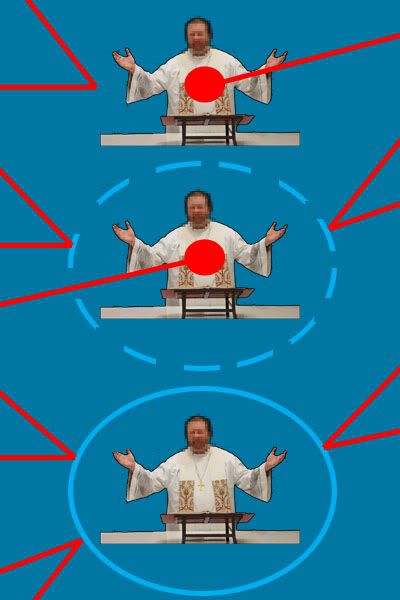
At the very end, Quang asked the congregation to keep our pastors in our prayers. He described how pastors often face the brunt of spiritual attack, not because they are more important than other Christians, but because they provide the most visible face of the Church. When Satan causes pastors and leaders to stumble, then the outside perception of the Church is damaged leaving others with sentiments like, "Told you so - they're all hypocrites." He provided an amusing illustration, which I have more or less duplicated below:

A pastor, on their own (top), may be able to defend against some spiritual attacks, and yet may be easily taken unawares and blindsided. Two people together (middle) praying for a pastor, may exert yet further spiritual support. But if an entire congregation (bottom) were to pray sincerely, then a leader should be well protected against attack.

At the end of the service, the worship band played the response song Jesus Paid It All. At this point, I felt pretty moved, and I had this awkward feeling of tears at the back of my eyes (which I held back, of course). But I was really touched by the words in the song of the Saviour speaking (to you, me, to his people): "Thy strength is indeed small," and the crimson stain of sin being washed white again.

JESUS PAID IT ALL
Elvina M. Hall, 1865

I hear the Savior say,
“Thy strength indeed is small;
Child of weakness, watch and pray,
Find in Me thine all in all.”

Jesus paid it all,
All to Him I owe;
Sin had left a crimson stain,
He washed it white as snow.

For nothing good have I
Whereby Thy grace to claim,
I’ll wash my garments white
In the blood of Calv’ry’s Lamb.

And now complete in Him
My robe His righteousness,
Close sheltered ’neath His side,
I am divinely blest.

Lord, now indeed I find
Thy power and Thine alone,
Can change the leper’s spots
And melt the heart of stone.

When from my dying bed
My ransomed soul shall rise,
“Jesus died my soul to save,”
Shall rend the vaulted skies.

And when before the throne
I stand in Him complete,
I’ll lay my trophies down
All down at Jesus’ feet.

Monday, September 15, 2008

Easy to preach; difficult to practice


How can I now allow this man
To hold dominion over me?
This desperate man whom I have hunted
He gave me my life. He gave me freedom.
I should have perished by his hand
It was his right.
It was my right to die as well
Instead I live... but live in hell.

These words are sung by Javert in Les Misèrables, a police officer who had spent much of his life on a vengeful quest to bring a criminal who had escaped him many years earlier to justice only to find too late the error of his unforgiving quest.

Judgement and anger are two negative reactions that I struggle with on a daily basis. Forgiving in the absence of apology, for me, is difficult. Forgetting is nearly impossible. One chance encounter can often ruin my entire day, and subsequent days when the encounter finds its way once again into my recollection.

Today, for instance, a friend and I walked to Queen’s Park subway station. There was a line at the turnstiles so I lined up with her. When she had just passed through the turnstiles, a man (and someone behind him) appeared to be edging their way into the vertical line diagonally. I rushed ahead and swiped my pass, hearing the man trying to bud in swear under his breath: “Ugh, that guy just budded me.”

On the way down to the subway platform, my friend and I took the stairs, and the man took the adjacent escalator. On his way past me, he slammed his hand down on the rubber escalator railing to make a loud noise. This only served to further aggravate me, since I knew it was him who was clearly trying to bud into line. So his offences included not only trying to bud in but also thinking he had the right of way and belligerently being unable to keep his anger to himself.

Now once we get to the subway platform, my friend and I take separate routes; she goes north and I go south. So sitting by myself I had plenty of time to stew. In my head I have a tendency to replay scenarios over and over imagining how things might have turned out if I had reacted to the offense (these scenarios usually tend to get more angry and outlandish as I continue to imagine) and to work myself into a state of very high tension. Still, while I am reluctant to let go of the anger, I know intrinsically that these responses are not optimal. Not only are they not good for my psychological and physical well being, but they are also contrary to God’s direction for our lives.

MATTHEW 5 (NIV)
Love for Enemies
43"You have heard that it was said, 'Love your neighbor and hate your enemy.' 44But I tell you: Love your enemies and pray for those who persecute you, 45that you may be sons of your Father in heaven. He causes his sun to rise on the evil and the good, and sends rain on the righteous and the unrighteous. 46If you love those who love you, what reward will you get? Are not even the tax collectors doing that? 47And if you greet only your brothers, what are you doing more than others? Do not even pagans do that? 48Be perfect, therefore, as your heavenly Father is perfect.

And so God calls on us to love not only those who are kind to us, but those who are not. Still this is very difficult, especially for me, as I often give into anger against thoughtless strangers quickly. Then I began to doubt: we are called to love those who offend us and who are unrepentant. Yet God, in his infinite mercy, still does not forgive those who do not believe or seek forgiveness.

Of course the answer to this came to me as quickly as the rebellious thought appeared. God has in him the authority to judge because he is just and blameless. In fact, today during lunchtime fellowship the idea was brought up that God must be just. As such, the sacrifice of Jesus’ life was required for our atonement – we as sinners could not simply be pardoned. We, as sinners, though forgiven are imperfect and unworthy. The role of judge is not ours to take upon ourselves.

JOHN 8 (NIV)

7When they kept on questioning him, he straightened up and said to them, "If any one of you is without sin, let him be the first to throw a stone at her." 8Again he stooped down and wrote on the ground.

9At this, those who heard began to go away one at a time, the older ones first, until only Jesus was left, with the woman still standing there. 10Jesus straightened up and asked her, "Woman, where are they? Has no one condemned you?"

11"No one, sir," she said.

"Then neither do I condemn you," Jesus declared. "Go now and leave your life of sin."

Despite knowing these things in my head, I still lacked the will or the faith to put them into practice. The blood was still pumping through my veins. And so, I closed my eyes, and I recited the Lord’s prayer, with a bit of a revision…

MATTHEW 6 (NIV)

9b" 'Our Father in heaven,
hallowed be your name,
10your kingdom come,
your will be done
on earth as it is in heaven.
11Give us today our daily bread.
12Forgive us our debts,
[and help us too to forgive] our debtors.
13And lead us not into temptation,
but deliver us from the evil one.'

And as I recited this over again and again, I felt my pulse slow down. Still, I knew that my bitterness would not be so easily tempered. So I tried to picture the stranger who had offended me, this time without feelings of anger. I tried instead to imagine how I might have responded to the situation with the opposite approach, in a gentle way that would make it difficult for the other party to remain incensed. In this way, I calmed myself by envisioning a proper Christian approach to a challenging situation.

Then in popped into my head another instance today of an offense by a stranger. Still, not to be irked after making this much progress, I again tried to approach this situation from the other cheek, imagining a gentle and loving response.

In a way, these imaginings were much like a game. It is unlikely that I would naturally think of responding in these ways given a situation like this, and even more unlikely that I would be able to put it into practice. But by playing this game, I look to change my way of thinking so that one day this may be more than a game… completely usurping my quick and fiery temper.

The question then is, who am I? Certainly, I continue to answer many situations with unrighteous responses: negativity, anger, or scorn. But through God’s love I can call upon his power to walk towards being the kind of person that I desire to be – a Christ-like kind of person… if I am truly willing. It is that kind of submission that will be most critical, and will continue to challenge me and my rebellious selfishness.